Open Access Scenario Analyses (OASA)
The Open Access Scenario Analyses (OASA) project addresses current challenges in the financial and organizational dimensions of the open access transformation through various analyses and provides recommendations for the continued development of this transformation in Germany. The goal of the OASA project is to analyze various financial pathways for open access development and to assess their potential impacts.
Through systematic examination based on scenarios, a comprehensive understanding of the opportunities, challenges, and risks of advancing the open access transformation is to be gained.
Through diverse participatory formats, the development of recommendations, and knowledge transfer activities, the project supports operational actions at academic institutions and their libraries. This promotes structural development for the open access transformation in Germany through interaction with international stakeholders.

Project Structure
Data Collection, Aggregation, and Analysis (Work Package 1)
Work package 1 develops a conceptual framework for data collection that defines the type of data to be collected, the timing, and the level of detail, while taking various data sources into account. Data is then collected based on this framework. The data is subsequently aggregated and analyzed, supported by expert workshops. A key focus is on collaboration with relevant stakeholders and the continuous refinement of data aggregation and analysis. Finally, a concept for a sustainable data infrastructure is developed that takes into account various perspectives on the sustainable management of data and involves the participating stakeholders.
Scenario Development for Shaping the Open Access Transition (Work Package 2)
Work package 2 develops scenarios for the future direction of open access. Based on the modeling of cost and publication data in work package 1, scenarios are developed that address the economic perspective of the open access transformation. The development of these scenarios, based on the aspects mentioned above, is discussed in two workshops with experts. The experts’ feedback thus guide the further development of the scenarios and ensure their quality.
Quality Standards and Service Levels for Publication Service Providers (Work Package 3)
Work package 3 addresses the recommendation of the German Science and Humanities Council regarding the development of “quality standards and service levels” for publication service providers. These “quality standards and service levels” will be developed in a participatory process with relevant stakeholders to enable the “performance comparison of publication service providers”. In this way, the project addresses organizational and technical aspects of the open access transformation in interplay with work packages 1, 2, and 3.
Recommendations for the Implementation of the Open Access Transition (Work Package 4)
The aim of the project is to go beyond the analytical level and provide an impetus for the further development of the transformation. To this end, work package 4 will formulate recommendations for the future direction of the open access transformation. As a synthesis of the activities in work packages 1, 2, and 3, these recommendations aim to address transformation activities in the areas of commercial, science-led, and academically supported open access publishing from an integrated perspective.




Project Proposal
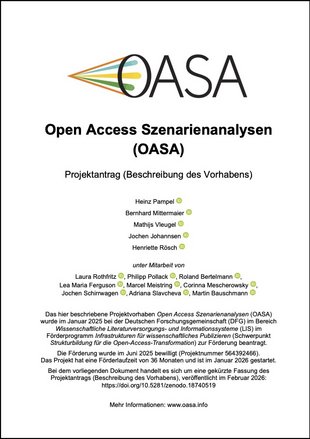
The full project description can be found in the published project proposal (in German).